Tuesday, September 7, 2010

The Warehouse at Camden Yards


Last week I had the good fortune to be at an Orioles game. I haven’t been there in years and years. In fact, the last time I was there was when Brady Anderson was our great power hitter. I had forgotten that such great views were accessible from the top levels of the ballpark. Here, this shot looks south over that end of the city, bordered by the warehouse on the left. Unfortunately, the north side view is now ruined by an ugly modern building. (It was more fun when we could see the Bromo Seltzer Tower.)

I actually used to work at Camden Yards during the mid 1990s. I had a lot of good times with the people I worked with and it yielded plenty of crazy stories. But, the crowds, like the one on my recent visit, tend to be cheerful. I worked there in the days when it was still newly opened. Then, some considered it the ultimate ballpark and I would often meet people from far away who were simply astounded by it. Early one morning some guys arrived in a beat up old car and told me that they drove for three days only to go to Camden Yards.

This old warehouse was always the most interesting thing about the ballpark. It was built for the B&O Railroad in 1905, back in the days when this area was all rail yards. According to baseballpilgrimages.com the warehouse is 1,016 feet long and 51 feet wide. In the days when I worked there it was not fully occupied. I remember during one of the first games of the season I wanted a restroom and my supervisor suggested that I go in the warehouse and find one. Well, a guard gave me a third degree and sent me to an upper floor, which was unfinished but had working bathrooms. It was pretty interesting up there so I took some time to admire the view. When I came back down the guard was annoyed that I spent so much time up there and indicated that she was watching me on closed circuit TV the entire time. Well, let’s just say I made a real effort to know the locations of handy public bathrooms after that.

Tuesday, August 17, 2010

Trees and Buildings


A couple of weeks ago I read an article in The Sun about Station North, that area around North Avenue and Charles Street. I think the article talked about how the area was not moving forward as it should. It included some hyperbolic statement about trees growing out of building windows. Well, what did I find on a recent sweltering summer day, but that very thing? They seem to be rooted in the surrounding architecture and not coming out of the window, but that is city life for you. I can’t remember correctly, but I believe this is in the 1800 block of Charles Street, down from Pearson’s and the corner of North Avenue.


Monday, July 5, 2010

A Fell’s Point Pier


I was in Fell’s Point the other week and noticed that this old pier is still there. It is cut off from land, but there is a fence around the general area and has been for some time. I don’t know what is up with it but every time I go there I expect it to be gone. There used to be 2 piers in this spot. One, I believe maybe this one, belonged to something maritime related, like the Navy or Coast guard. It wasn’t used much and it was fenced off from the public. The other one, which was next to it, was just rotting.

I'm a bit nostalgic about these piers. Back in the early ‘90s a friend and I used to take a lot of walks around here and explore the area. There were still a lot of those warehouses too and they had not been torn down or renovated. Since my friend was a guy I felt comfortable going around these areas and he even convinced me to walk out on some of these old piers. We also used to poke around the one in front of the old coffee warehouse, which is not part of the Frederick Douglas-Isaac Meyers Maritime Park.

It was fun but scary to go out on them as they were unstable but it was like being on a part of history. In those days we mostly saw local fishermen out on those docks and they were usually friendly. Towards the end, before the spot was sold and developed, I began to avoid the area as it became a gathering place for homeless people. The new pier by the coffee warehouse is pretty and functional but I wish I had photographed the spot in the old days.

Thursday, June 24, 2010

An Old White Coffee Pot


I just like this decaying White Coffee pot restaurant and I believe it is on the corner of Howard and Franklin. I’ve been watching it fall apart over the years because I sometimes pass it while going back and forth to the library. I have some dim memory of it being open, and then a phase where I wasn’t sure if it was open or closed. I also believe that in college a friend went to look at renting one of the places above the restaurant and was frightened away by the general decay of the area.


Wednesday, June 16, 2010

New Gaps in the Cityscape

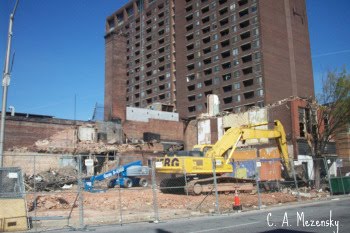
This was going to be a Wordless Wednesday but it didn’t quite make it. If I find a building being torn down I always stop to photograph it, even if I don’t quite remember what was there before.

The one above was on Eastern Avenue and Broadway but it fell down a couple of months ago. I happened by on the day when they were tearing down the remains. I’m sure it was an auto parts store as the person with me was reminiscing about how he used to buy car parts there. I don’t know the age of the building but it was one of the typical three story brick buildings you see all around Fell’s Point.

I photographed the remains above last summer, so it isn’t recent but I always like three pictures for Wordless Wednesday. It is on North Avenue and Charles. (I think?) This was some old Victorian thing and I believe a carryout at some point? This one really puzzled me as I’ve walked by it a thousand times and had no idea what was once there, except it was in bad shape and boarded up towards the end.


I was wandering down Park Avenue a couple of weeks ago (as you can see in last week’s Wordless Wednesday) and noticed that they were knocking down parts of Lexington Mall. That spurred me on to a photo expedition in the area as now I bet they’ll be knocking down everything around there. Again, I don’t remember what was here but I am not often on this street anymore. Actually, almost nobody is and during the past few years it’s been a bit of a ghost town. People only seem to use it as a shortcut to the light rail.

Friday, June 11, 2010

Stormy Sky


I actually took this photograph in January but it seems to fit the stormy summer mood of today. This should be on Cathedral Street somewhere, not far from the library.

I'm thinking of just turning this into a photo blog because I have so many other writing projects that I don't have time for more research. I'll research when I can, but I just love taking photos of things in Baltimore City. In the back of my mind I have a coal chute article planned but not researched yet. I'm suddenly seeing so many coal chutes around here. You never know whan something odd like that will preoccupy you.

Friday, April 23, 2010

Graveyard Lilies


A few weeks ago I was in Richmond, Virginia and visited the Hollywood Cemetery. While Baltimore certainly has its share of unusual cemeteries, I found this one to be rather intriguing, particularly the different kind of symbolism on the graves. If you want to study Victorian gravestone art, Hollywood Cemetery is the place to go.

Gravestones, like the ones in Hollywood Cemetery, originated as a way to keep the dead from rising from the grave. They were slabs or boulders placed over the ground where the body was buried. Soon, markers included names. Early images on gravestones were less than peaceful, though. Drawings of skeletons or other images of death served to remind the living of where they could end up if they did not live virtuously.

It was during the 1800s that the tone of images on gravestones began to change. At this time “garden cemeteries” replaced overcrowded churchyards and mourning became a much more elaborate practice, from clothing to length of time to gravestones. As many families lost loved ones during the Civil War it seemed that no family was untouched by an untimely death. It is no secret that the Victorians were overtly interested in death and the elaborate graves of the time reflect that. Lilies, like those on the gravestone above, symbolize purity, chastity, and were usually used on the graves of young women or babies. It was also used more generally to symbolize innocence in the face of God.


Resources

The Mystery of Graveyard Art and Symbols by Troy Taylor
Gravestone Symbolism
Cemetery Iconography

Tuesday, April 13, 2010

Knitted and plastic pink flamingoes


A couple of weeks ago another bit of guerrilla knitting popped up near where I work. This is on Mount Royal Avenue, which is heavily traversed by MICA students. So, I suspect it was one of them who put this up. On one side it says “Hey Hon” and on another side is this artfully sculpted flamingo. I’m not sure whether the bird is knitted or crocheted, but it certainly makes the piece.

I am really not a big fan of pink flamingos. Yet, for some reason it is traditional to have them all over the place in Baltimore. I tried to research why they are so popular here, but to no avail. But, I did find that in 1957 Don Featherstone designed and marketed the first plastic lawn flamingo. Previously, the company he worked for, Union Products, made only flat lawn ornaments (including flamingos). This young sculptor first made a duck for the company, and then developed the plastic flamingo sculpture. As both lawns and bright colors were popular during the 1950s, these ornaments became very popular.

Plastic pink flamingos have gone in and out of fashion in many places but have become a city symbol here in Baltimore. Some first associate our city with them because of the John Waters film Pink Flamingos (Roger Ebert viewed it with distress). In recent years they have popped up in droves on Baltimore lawns and are often used to represent kitschy hospitality in the city. This winter, Ravens fans took the flamingo craze to a new level by adding flocks of purple and black flamingos to their lawns. As baseball season opens, many are replacing the purple flamingos with orange ones, to display the orange and black colors of the Baltimore Orioles baseball team.

Resources

Pink Flamingos

Wednesday, April 7, 2010

Traveler and Little Sorrel – tales of two horses

The week I went to Charlottesville seemed to be the week equestrian statues of Robert E. Lee merged with guerrilla knitting. When I was out walking that week I was amused to find that someone had fitted the double equestrian statue of Lee and Jackson at Chancellorsville with a set of leg warmers. (This is the one near the Baltimore Museum of Art.) While I know that some people may find this disrespectful, I was tickled by it. Ever since somebody fitted the horses with leg warmers I've seen people snapping photos and the horses seem to look quite proud. I think this is a good way to draw attention to this statue, which I have always been quite fond of, especially since I recently visited Chancellorsville. But, while researching this statue it was the horses that piqued my curiosity.

Recently I called a friend about this statue because one of his favorite Civil War trivia questions is, “What is the name of Robert E. Lee’s horse?” (Traveler, in case you ever meet him and he asks you.)

Me: “I also now know the name of Stonewall Jackson’s horse. It is Little Sorrell.”

Him: “Yes, Little Sorrell is on display at the Virginia Military Institute Museum. We’ll go see him.”

Hmmmm………..

While both horses are famous, Traveler led a more genteel life, though with multiple identities. That animal later known as Robert E. Lee’s pale gray horse was named Jefferson Davis when he was born in 1857. He was originally owned by James Johnson, who won blue ribbons for the horse at the local county fair. During the early part of the Civil War the horse, then named Greenbriar, was owned by Confederate Captain Joseph M. Broun. It was during this time that General Robert E. Lee spotted the horse and aimed to acquire him. Lee, who enjoyed the horse’s skilled trotting, renamed him Traveler.

Lee’s son Robert E. Lee Jr. noted that the general was quite close to his horse. After the war Lee kept Traveler and continued riding him. After General Lee became president of Washington College in Lexington, Virginia, Traveler spent his retirement grazing on the school’s lawn. While Lee died in September 1870, Traveler was not far behind when he died from tetanus after he stepped on a nail in June 1871. He is buried at the Lee Chapel at Washington College.

Unlike the elegant Traveler, Little Sorrell was a small horse often described as ugly or dumpy. Yet, he was a smart horse and a good ride. Jackson had originally taken to Little Sorrell when he looked to purchase horses for both his wife and himself. Jackson found himself riding the little horse more often than the horses he bought for himself. Jackson soon found that the awkward looking little horsed was a nimble trotter and nicknamed him “Fancy”. The horse also kept his head in battle and was not often spooked by the noise of cannons or gunfire. Stonewall Jackson died at Chancellorsville, the scene that inspired the double equestrian statue photographed above. He was riding Little Sorrel when he was shot.

After General Jackson died, Little Sorrell was captured and re-captured a number of times, until the Yankees got tired of this and gave him back to the Confederacy. The horse lived for about 20 years more after the war, making the circuit of southern fairs and even appearing at the 1885 New Orleans World’s Fair. Ladies in the south had much affection for Little Sorrel, clipping souvenir hair from the horse’s mane and tale and fashioning them into rings and bracelets. After the World’s Fair Little Sorrell’s health quickly declined and he ended up living at an old soldier’s home in Richmond, Virginia. During his last months, Little Sorrel was so feeble that the veterans at the home devised a sling to lift the horse whenever they wanted him to stand. Unfortunately Little Sorrell met his end when this sling slid off on him one day and he fell, breaking his back.

As my friend alluded to, a lot of people have seen Little Sorrel since he died. This horse is indeed on display at the Virginia Institute Military Museum if anyone wants to see his stuffed effigy. If you would like to see Traveler and Little Sorrel in the form of the double equestrian statue of Lee and Jackson, it is near the Baltimore Museum of Art. It is across the street, on the western edge of Art Museum Drive. For more details and a map, see this page about the Lee and Jackson monument on the Monument City blog.

Resources

Robert E. Lee and his horse by Mike Higgins

Little Sorrel on the Roadside America web page

Thursday, April 1, 2010

A Big Pile of Fire Hydrants

Last winter, just before Christmas, I spotted this pile of fire hydrants on Howard Street. That entire week people kept excitedly asking, “Did you see the fire hydrants??” I never did find out the story behind this, but it was an amazing sight and has been in the back of my mind ever since. The pile was in front of the A. E. Harrington Plumbing Company, which I also tried to research (to no avail) when I photographed the tiny Statue of Liberty they have on the roof. Well, even though I have no research I decided to post this simply because it was interesting.

I do like fire hydrants and way back I did write an entry on the history of fire hydrants so that will have to do until I find out more about this pile, if I ever do.

Tuesday, March 16, 2010

Visiting Lee Park in Charlottesville, Virginia


This post isn’t about Baltimore, but I wanted to write about Lee Park in Charlottesville, Virginia. I visited there recently and I just liked it. We cut through the park to get to a bookstore and the first thing I saw was some guerrilla knitting on a tree. I was tickled, as I usually am when I find knitting on trees. But, I am not familiar with the Charlottesville knitting scene so I didn’t turn up any information about that. Instead I will write about this interesting statue of Robert E. Lee and his horse Traveler, which is also in the park.

In 1917, a prominent local citizen, Paul Goodloe McIntire, bought this property. He had a house removed from the lot and tuned it into a formally landscaped park. Eventually gave it to the city of Charlottesville, intending it as a memorial to his parents and also as a place for an equestrian statue of Robert E. Lee and his horse Traveler. For McIntire, getting this statue in place was a long and worrisome adventure. He commissioned Henry Shrady, who at the time was engrossed in his most famous work, an elaborate equestrian statue of Ulysses S. Grant.

Between finishing that project and his poor health, Shrady made little progress on the Lee statue over the next few years. On his deathbed in 1922, Shrady begged his doctors to keep the cloths covering his wet clay model wet. They didn’t know what he was talking about and so the model was ruined when the canvas dried and stuck to the fine details of the sculpture. Another artist, Leo Lentelli, worked diligently to research the details and to finish the sculpture. The Roman Bronze Works finally cast it in New York during the winter of 1924. On May 3rd, 1924, it was unveiled as Lee’s great granddaughter (aged 3) Mary Walker Lee pulled away a Confederate flag.


Resources

A Guide to the History and Gardens of Lee Park

Lee Park

Revival

I haven’t had time for this blog in awhile, and frankly I wasn’t sure what to do with it. It seemed a little stiff in the writing style. I wondered if I should delete this blog and merge it with my new one, A Baltimore Gardener. But, the new blog makes me see more clearly what I can do with this one. Plus, people seem to be reading and linking to posts here so I won’t take them down. So, while I won’t update this as much as that one I do want to keep it and add to it, concerning odd things I find around the city. For example, guerrilla knitting is suddenly popping up wherever I go. I once wrote about this in my Sweater Trees post here. Plus, I’ve been dying to write about an odd pile of fire hydrants that I saw on Howard street just before Christmas. More pictures and historical bits to come!

Tuesday, September 29, 2009

Rippel’s Spring


In the woods between the Wyman Park Dell and Johns Hopkins University sits this old fountain stone. I’ve seen it for years without actually knowing what it was. Apparently this spring was in use for many years but didn’t have a name until the 1930s, when it was refurbished with this stone, which came from a different spring. It reads, “Presented by H.S. Rippel 1895”. Though the spring was heavily used in the 1930s and ‘40s it dried up about 25 years ago. I got some good leads on this fountain stone from Monumental City and went to the Maryland Room at the Pratt expecting to find little or nothing on this fountain. But, I lucked into some old newspaper clippings in the vertical files, mostly from The Baltimore Sun.

H.S. Rippel was a Baltimore businessman who donated money for this spring, which originally belonged to a location in Druid Hill Park. Rippel was the builder who erected an early City College building at Howard and Centre streets. According to the Sun, the fountain stone was likely cut by Rippel’s own workmen. The original Rippel’s spring was in Druid Hill Park and according to an October 19, 1941 Baltimore Sun story, it was shut down in the 1920s by the health department due to contamination. Water pollution was a fear and problem in Baltimore from the beginning of the 1800s, when “progress” began to cause problems with the water supply. In the early to mid-twentieth century, the Baltimore Health Department worked diligently on shutting down unsafe public fountains. Like Rippel, the springs and fountains in Druid Hill Park were shut down but later many were converted to piped in city water.

The spring in the Wyman Park Dell had no name until this stone was moved and the spring refurbished. Photographs from the 1941 Sun story show a “bubble fountain” (what we know as a modern drinking fountain) near the bridge over Stoney Run. This fountain fed from Rippel’s Spring. Also according to that Sun article, Rippel’s Spring was “once popularly regarded as highly valuable for it’s radium content.” Kids often made pocket money bottling and selling this water in the neighborhood. In 1983 The Baltimore Sun Article interviewed a man named Web Kefauver. He related that in 1925, when he was a boy, he lived in the Tudor Arms apartment building and sold water from Rippel’s spring. He bottled the water and loaded up his wagon, taking it to local apartments. The water was then hauled up via the dumbwaiters, a common feature in those old buildings. Mr. Kefauver charged 50 cents a week for his services.

Even though the Wyman Park spring was never shut down, public spring fell from popularity after World War II.A 1947 Sun article warns against drinking from springs and streams because of the threat of typhoid fever. It mentions threats of severe contamination and dysentery, among other things. Officials at that time concluded that even springs like Rippel, which were in wooded areas, were still probably contaminated because they passed through areas of the city with poor sanitation. A 1952 Baltimore American story echoes these fears of contamination and typhoid and was still reporting cases of illness.

The 1983 Sun article also reported Mr. Kefauver’s regrets that the spring was drying up. Then, a representative from Johns Hopkins University said that the water table was dropping. Also, there was a high nitrate content in the water and there were traces of coliform bacteria, probably from animal waste. Currently the spring is no longer working, but it still remains an interesting bit of neighborhood history.

Resources

Monumental City, "Hope Springs Eternal"
The Sunday Sun, October 19, 1941
The Baltimore Sun, February 6, 1983
The Baltimore American, 1952
(Exact authors and article titles will be updated soon.)


Friday, July 3, 2009

Sundials

Recently I was working on an article for my gardening column and I wanted a local tie-in to a sundial. I intended to write about setting a sundial because the summer date and solar conditions are best for this on June 15. (It is also good on April 15, September 1 and December 25.) However, the sundial I dug up was much more interesting instead. The segment in this photograph is from a sundial in Druid Hill Park that is 4 feet high and tells time in 14 different parts of the world, including, as you see here, “Rio Janero”. This sundial was once accurate but with daylight savings time it is no longer so. When it was refurbished during the early part of the 20th century it was covered in bronze. From what I read I guessed that that underneath of the bronze is stone. It was presented to the park buy the sculptor, Peter Hamilton, in 1892. It was moved on at least one occasion, and an old Baltimore Sun article I found in the Pratt Maryland room suggested that a tree was in the way.

Nowadays we don’t have much use for sundials but they are thought of as the first scientific instrument. They officially date back to the Egyptian period. The piece that makes the shadow is called a gnomon. In the old, old, old days, the gnomon was the sundial and it is suggested that Egyptian obelisks served this purpose. Mechanical clocks that we know were invented in the 1300s. They were considered not as reliable as the sundial, which is the true time. It was not until the late 1800s that clocks were considered reliable. Instead, people like had “noon marks” on their kitchen floors to tell when it was time to call the clan in for food. In times past, some did not consider their gardens complete unless a sundial was in it. In Victorian times ornaments such as sundials were very popular, hence the need to include one in Druid Hill Park. I say that lightly because with having to figure out 14 different times around the world for a sundial, Peter Hamilton’s work goes well beyond ornament.

Resources:

Setting an unusual sundial

Sundial history

Thursday, June 18, 2009

Magnolias


I’ve always loved magnolia blooms and have a wonderful memory of one. Some years back I was taking classes at a local community college. This was my first summer there and I lived about a ½ hours walk from the place. The long June evenings provided me daylight long after the class was over, so I could walk home. One evening I walked the warm deserted streets past a local house museum. This house had a magnolia tree in the yard and the branches bent low and close to the iron gate that separated the yard from the street. One beautiful magnolia was at about eye level. I could smell the clear lemony smell. What can I say? I plucked it and took it home with me, where it scented our house for three days and then collapsed into a pile of rubbery brown leaves.

Magnolias come in a wide number of varieties. Even though we mostly see white, there are some attractive pink and yellow ones. It is the official state flower of both Louisiana and Mississippi. Yet they grow nicely up north here and can even be grown from seed. Generally magnolias need lots of space and a bit of air around them, but can also do well in part shade. The area should be sheltered but not so sheltered that it gets colder than the surrounding area in winter. The soil should be slightly acidic. They don’t need to be pruned unless damaged by snow and ice. If this happens, prune away the damaged branches and that will allow the rest of the tree to recover.

Resources:

Magnificent Magnolias

How to grow magnolia trees

Tuesday, June 16, 2009

The Byrd


Recently I paid a visit to the Byrd theatre in Richmond, Virginia. I’m a movie buff so I have to see things like this and I was quite impressed with the Byrd. This theatre was named for William Byrd II, the founder of Richmond. It opened on December 24, 1928 and was intended for use both as a sound and silent theatre, with both types of equipment. Prices then were 25 cents for a matinee and 50 cents for evening, with children paying 10 cents. The first movie shown was a comedy called Waterfront. True to the intented dual sound/silent use for the Byrd, Waterfront was a silent film that was shown with sound added.

The Byrd seats 1,400 seats and has a Wurlitzer organ that rises out of the front of the stage. Originally meant for silent movies, the organ is now played every Saturday night before the evening show. The murals in the lobby depict scenes in Greek mythology and were hand painted in a studio in New York. A humongous chandelier, which hangs over the auditorium, was assembled as the building was constructed. This chandelier weighs two and a half tons. The predominant decor inside the building is very ornate, mainly featuring gold leaf and marble. The Byrd has never been remodeled, but there were a few repairs and adjustments from time to time. Now, it is run by a non-profit organization called The Byrd Theater Foundation. They survive as a second run movie house and it costs only $1.99 to get in, so this allows many people to experience this bit of movie history.

Resources:

Richmond Movie Palace-The Byrd Theater

Byrd Theater and Foundation

Monday, May 18, 2009

Sherwood Gardens


As long as I have lived in Baltimore, I had never been to Sherwood Gardens until recently. I was surprised to find that it is so close that I could walk to it. The area itself is really a large plot of open ground filled mostly with azaleas, trees of all types, and of course, the famous tulips. The look this year is overwhelmingly pink and white, but old newspaper and magazine articles from the Pratt library Maryland room tell of a much greater variety of colors in years past.

Mr. Sherwood, the originator of the garden, was actually quite welcoming to visitors considering that he began the gardens in the 1920s on his private property. He said that he wanted to plant a few plants to cover some bare spots and the garden spread out from there. Ultimately the garden became famous for the many tulips, azaleas and flowering trees. Planting the bulbs was a large undertaking. According to a Style magazine article, in 1937 Sherwood had 42,000 blooming tulips in his garden. Sherwood’s chief gardener, Clarence Hammond, would order the bulbs from Holland at the end of the summer and they were shipped over by boat. It took a month for Hammond and his crew to plant all of the bulbs. That was not the end of the work. Tulips can come back year after year, but they loose their strength and the blossoms become less showy. In spring, after the bulbs bloomed and the foliage died back, Hammond and his assistants would have to dig them up all over again. Now, Sherwood is a free, year round public park maintained by the Guilford Association. There were 80,000 tulips this year. Most of these were dug up and happily carried home during the annual tulip dig, which lets the public remove the spent bulbs for a very small fee.

Resources:

Guilford Association

Sherwood Gardens: cultivating a Baltimore tradition

Thursday, April 16, 2009

Forsythia


Every spring I look forward to the forsythia blooming. Here, this blooms on a scruffy patch at the base of the Howard Street Bridge. Usually a homeless person lounges about in this area, but since this was a rare occasion when he wasn’t here so I whipped out my camera. I am partial to forsythia because it reminds me of my childhood. When we were kids we had some that were so big that we used to play house inside of them. There were several different bushes growing in a row and it seemed like there were several “rooms” inside them.

As you could guess by this forsythia bush’s location, forsythia are very easy to grow and require little maintenance or special conditions. They are tolerant of polluted areas. Ideally, they require full sun, well-drained soil. Technically, forsythia are deciduous shrubs and are a member of the olive family. The leaves drop off in late fall but do not turn any exciting colors. Forsythia is of Asian origin and was discovered by Robert Fortune in the 18th century. Forsythia was introduced to America at the turn of the 20th century. The shrub was named in honor of William Forsyth, who was a prominent gardener in England

Forsythia blooms in March and April with yellow blossoms early in the spring and the blossoms are always on the previous year’s growth. As evidenced by my childhood activities, it can grow large, often between 4 and 6 feet tall and with a spread from three to five feet wide. It also grows fast, from 1-2 feet per year. It leafs out nicely and is often used for privacy. Single forsythia look best wild but if they are in groups they should be trimmed. Many gardeners prefer the unruly look and hesitate to prune them. Forsythia can be grown from cuttings. Cut a 3-6 inch branch from an area of new growth and then place is a pot of moist soil, keeping it moist. It will slowly take root over a few weeks.

Resources

How to Grow and Care for Forsythia

Planting and caring for forsythia

About Forsythia